
Exploring Quarkus: Making Java Fast, Modern, and Cloud-Ready
A beginner-friendly guide to understanding why Quarkus is becoming the favorite Java framework for cloud developers.

After my last post, someone left a comment saying, “I’d love to see some Quarkus.io coverage 🙂.”
That got me curious. I’ve been hearing about Quarkus for a while, especially in developer circles talking about modern, cloud-native Java. So, I decided to take a closer look — and honestly, it’s quite an interesting framework.
If you’ve worked with Java or Spring Boot, this will feel familiar — but Quarkus brings a refreshing twist to how Java applications are built and run.
What is Quarkus?
Quarkus is a next-generation Java framework designed for building fast, lightweight, and cloud-friendly applications.
It’s open-source and built by Red Hat, known for its enterprise-grade software. Quarkus is called “Kubernetes-native” because it’s made to run smoothly on containers, microservices, and serverless platforms — all the things modern apps rely on.
Traditional Java applications used to take time to start and needed a lot of memory. That was fine in the old days of big servers, but in today’s cloud world where apps scale up and down quickly, that’s a problem.
Quarkus fixes this.
It’s optimized for both the JVM (like any normal Java app) and native compilation using GraalVM, which makes it super fast and lightweight. So you get the reliability of Java with the speed of modern cloud tools.
Why Developers Love Quarkus
Here’s why developers are talking about it:
Starts in milliseconds — no more waiting ages for your app to boot.
Low memory use — great for microservices and cloud environments.
Live reload — make a change, hit save, and see it instantly (no restarts).
Native compilation with GraalVM — turns Java apps into super-fast executables.
Cloud and container ready — works smoothly with Docker and Kubernetes.
Reactive and event-driven support — integrates easily with Kafka and real-time systems.
Dev Services — automatically starts containers like PostgreSQL or Kafka for you in dev mode.
All of this makes Quarkus faster to code with and cheaper to run — a rare win-win.
How It Feels to Code with Quarkus
Let’s take a simple example.
You create a REST API:
@Path(”/hello”)
public class HelloResource {
    @GET
    @Produces(MediaType.TEXT_PLAIN)
    public String hello() {
        return “Hello from Quarkus!”;
    }
}
Then you run:
./mvnw quarkus:dev
Now open http://localhost:8080/hello
Boom — your app is live in seconds.
No long builds. No waiting for redeployments. Just save and see results instantly.
That’s the kind of developer experience that makes Quarkus fun to work with.
Quarkus vs Spring Boot — Simple Comparison
If you’re from a Spring Boot background (like most Java developers), here’s how Quarkus stacks up:
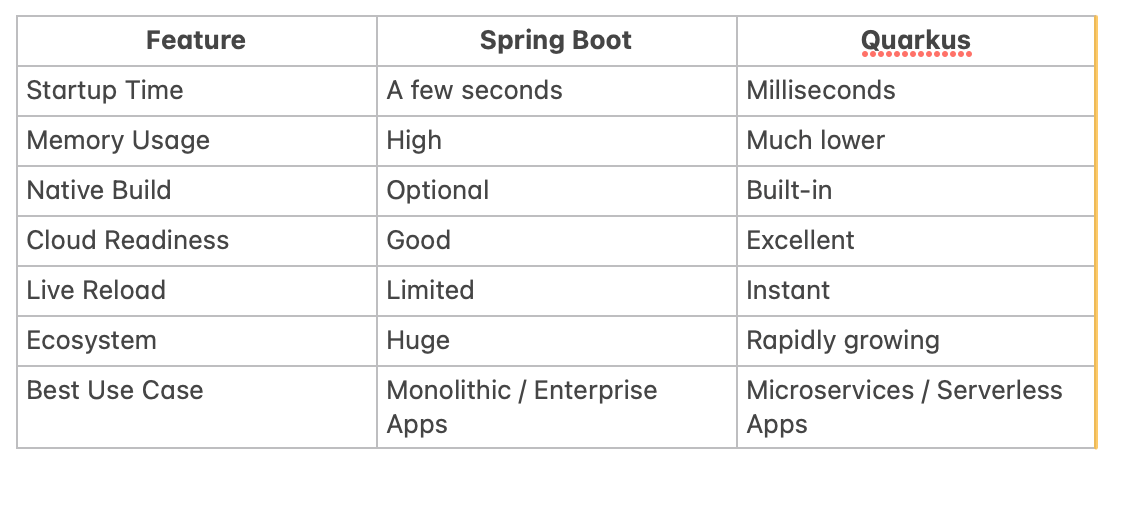
Spring Boot remains fantastic for enterprise and monolithic applications, but when you’re building microservices, serverless functions, or anything that needs to start and scale fast — Quarkus stands out.
Where Quarkus Shines
You’ll find Quarkus being used for:
Microservices that need quick startup and low memory
APIs that scale rapidly on Kubernetes
Event-driven systems with Kafka
Serverless and edge deployments
Energy-efficient apps (less resource usage = greener code!)
Because it’s built by Red Hat, Quarkus also fits comfortably into enterprise systems while staying developer-friendly.
My Take
Quarkus feels like Java redesigned for today’s world — fast, lightweight, and cloud-ready.
It doesn’t try to replace Spring Boot but gives developers another strong option, especially when performance and scalability matter.
If you love Java but wish it felt more modern, give Quarkus a try. Create a small app, run it in dev mode, and you’ll instantly see how quick and easy it feels.
Sometimes, all it takes is one framework to make you enjoy Java again.
Thank you 🤩